•••Urges Media to Verify Political Claims Before Publication
By: Aaré Alao Olalekan

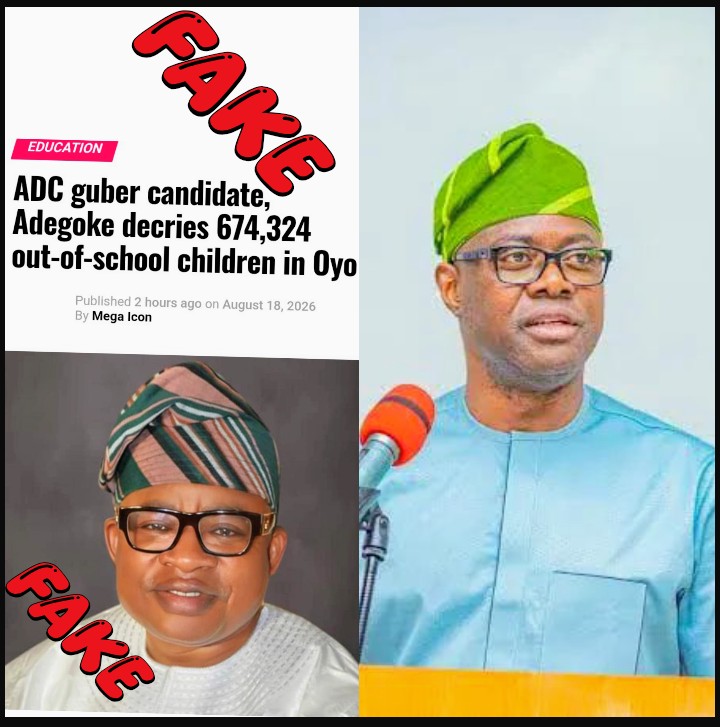
Concerned stakeholders have challenged a recent claim attributed to the Oyo State ADC Governorship Candidate, Hon. Adegoke Adegboyega, in which he cited 674,324 out-of-school children in Oyo State, describing the figure as insufficiently contextualised and urging political actors to present the latest available data when assessing the state of education.
A review of available records shows that the 674,324 figure is traceable to data from the Planning, Research and Statistics Department of the Oyo State Ministry of Education in 2022. The 2024 academic study on Oyo State reproduced the Ministry’s data, which estimated 674,324 children aged 3–18 as out of school. This is important because the figure should not be presented as though it represents a newly conducted 2026 headcount.

It is also worth noting that an earlier 2018 Oyo State Government survey recorded 702,643 out-of-school children aged 3–18. The difference between the 2018 and 2022 figures further demonstrates why data must always be accompanied by its year and methodology. Consequently, stakeholders said Hon. Adegoke should tell Oyo people precisely which dataset he is relying upon instead of presenting an old statistical estimate without adequate context. EgalitarianVoice
More importantly, stakeholders said any assessment of education in Oyo State must take into account the interventions implemented by the administration of His Excellency, Engr. Seyi Makinde, since 2019. According to the Oyo State Government’s own roadmap, the administration reported returning 54,569 children to school by 2021, while also completing 60 model schools, constructing and renovating over 700 classrooms and other infrastructure, and providing 26,500 desks, teachers’ tables and chairs. It also reported the employment of 5,000 teachers.

The Oyo State Ministry of Education has further documented the administration’s introduction of free education, regular payment and promotion of teachers, provision of textbooks and notebooks, science equipment, intervention classes for SS3 students and construction of more than 50 model classroom buildings. The Ministry specifically says its multi-dimensional approach to tackling the out-of-school challenge resulted in 54,569 pupils and students being enrolled back into school.
UI Emerges Nigeria’s Highest-Ranked University in July 2026 Webometrics
Defection Domino Effect: APC’s 2027 Master Plan Revealed?
It is therefore fair to ask whether relying heavily on a historical figure without adequately explaining its year, source and subsequent developments gives Oyo citizens a complete picture of the state’s education sector. Political opposition is an essential part of democracy, but criticism should be built around current evidence, transparent comparisons and credible alternatives, rather than statistics stripped of their context.
The challenge of getting every child into school remains serious and deserves sustained attention from every political party and stakeholder. But the debate should also recognise measurable interventions made since 2019. Oyo State itself has reported that it has consistently allocated more than 20 per cent of its budget to education, alongside removing school fees and recruiting teachers.
Hon. Adegoke is therefore entitled to criticise the government and raise concerns about education, but the people of Oyo deserve to know the exact year, source and methodology behind every figure placed before them. If newer data exists, it should be produced. If the 674,324 figure remains the latest comparable estimate, then it should be clearly identified as such.

Speaking on the matter, Aaré Alao Olalekan, a statistician, cautioned media organisations to thoroughly fact-check claims made by politicians, especially statistical figures, as the 2027 elections draw closer. He stressed that while politicians are free to make claims and present figures, the media has a responsibility to independently verify such information before publishing it.
“With the 2027 elections approaching, the public deserves accurate, verified and properly contextualised information to make informed decisions. A figure can be technically correct and still become misleading when its year, source or context is omitted. Before putting any statistical claim into the public space, the media must ask: Where did the figure come from? When was it generated? Is it still relevant, and what has changed since then?” — Aaré Alao Olalekan stated.

Facts matter. Context matters. And in a serious 2027 political conversation, old statistics should not be presented without telling the people exactly how old they are.
🔗 Join Our WhatsApp Channel for Latest News
https://whatsapp.com/channel/0029Va9qtzXHwXbIyBGtjk2o
🔗 Join Our Telegram Channel