FACT CHECK: Do 140m Nigerians Live In Poverty As Peter Obi Claimed?
Claim
“Today we stand before the world as a nation with an extraordinarily large population living in poverty and severe hardship – over 140 million.”

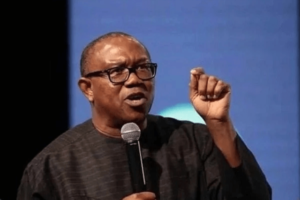
Peter Obi, Presidential Candidate of the Nigeria Democratic Congress (NDC), made the claim in his Independence Day address as Nigeria marked its 66th anniversary, on Thursday.
Obi also cited other indicators of hardship, saying Nigeria had “over 18 million” out-of-school children, that “over 40 million Nigerians will be in extreme hunger by the end of 2026,” and that youth unemployment and underemployment stood at “over 35 million.”
He also cited drug abuse and low life expectancy among the country’s major challenges.
Findings
Available evidence confirms that poverty, food insecurity and other forms of deprivation are widespread in Nigeria, but it does not conclusively establish Obi’s specific claim that more than 140 million Nigerians currently live in poverty and severe hardship.
The latest official national multidimensional poverty survey by the National Bureau of Statistics (NBS) found that 63 per cent of Nigerians, or about 133 million people, were multidimensionally poor.
The survey was conducted between November 2021 and February 2022 and measured overlapping deprivations in areas including education, healthcare, sanitation, electricity, cooking fuel, housing and food security.
However, that figure is not a 2026 estimate.
More recent poverty estimates are higher. The World Bank’s April 2026 Nigeria Development Update estimated that 63 per cent of Nigerians were living below the national poverty line in 2025, equivalent to roughly 140 million people. The estimates were based on the 2018/19 and 2022/23 Nigeria Living Standards Surveys.
PwC’s 2026 West Africa Economic Outlook projected Nigeria’s poverty rate at 62 per cent in 2026, equivalent to about 141 million people. PwC said the projection was based on straight-line estimates using data from the 2018/19 and 2022/23 Nigerian Living Standards Surveys.
These figures provide substantial evidence that more than 140 million Nigerians could be living below a monetary poverty line around the period covered by the claim.
They do not, however, establish that 140 million Nigerians are living in multidimensional, extreme or “severe hardship” conditions.
Nigeria’s Worst Days? Obi Blames Tinubu for Economic Collapse, Mass Poverty
The distinction is important. The NBS’s multidimensional poverty measure captures several simultaneous deprivations, while monetary poverty estimates classify people according to whether their income or consumption falls below a specified poverty line. The two measures are not interchangeable.
Food insecurity
There is stronger evidence of the severity of Nigeria’s food crisis, although it does not substantiate Obi’s exact figure of 40 million people facing extreme hunger.
The United Nations Office for the Coordination of Humanitarian Affairs (OCHA) said nearly 35 million Nigerians are likely to face acute food insecurity during the 2026 lean season, with 5.8 million of them in Borno, Adamawa and Yobe (BAY) states. OCHA also described severe food insecurity and malnutrition as endemic.
The UN Population Fund (UNFPA), citing the 2026 Humanitarian Needs and Response Plan, similarly reported that 35 million Nigerians could face acute food insecurity during the 2026 lean season, including 5.8 million people in the BAY states.
The World Food Programme also puts the projected number at nearly 35 million, with the BAY states accounting for about 5.8 million.
Therefore, Obi’s warning about a major hunger crisis is supported by current humanitarian projections. However, the available UN figure is about 35 million, rather than the more than 40 million he cited.
“Jesus H@tes Poverty, Never Visited the Poor” — Pastor David Ibiyeomie
Obi also said Nigeria has “over 18 million” out-of-school children.
UNICEF’s 2024 assessment reported that 10.2 million children of primary-school age and 8.1 million children of junior-secondary-school age were out of school, giving a combined figure of about 18.3 million.
UNICEF described the situation as an education crisis.
The figures support Obi’s reference to more than 18 million out-of-school children. However, they cover specific school-age groups and should not be presented as a current 2026 count of all Nigerian children outside school.
Youth unemployment
Obi said youth unemployment and underemployment affect “over 35 million.”
The ActionAid Nigeria’s 2025 State of the Nigerian Youth report gives a substantially higher estimate, stating that nearly 80 million young people, representing 53 per cent of Nigeria’s youth population, were unemployed.
However, the figure is based on ActionAid’s cited sources and its presentation of the youth employment situation. It should not automatically be treated as an official National Bureau of Statistics unemployment figure.
The ActionAid estimate therefore provides evidence of serious employment challenges among young Nigerians but does not independently validate Obi’s specific “over 35 million” estimate.
Drug use
Obi cited drug abuse and substance misuse as another major challenge, saying the rate was 14 per cent compared with a global average of six per cent.
The National Drug Law Enforcement Agency (NDLEA), citing the 2018 National Drug Use Survey conducted by the NBS with technical support from the United Nations Office on Drugs and Crime, said an estimated 14.4 per cent of Nigerians aged 15 to 64, or about 14.3 million people, used at least one psychoactive substance in the previous year.
This supports the 14 per cent figure cited by Obi, although the survey was conducted in 2018 and therefore should not be presented as a current 2026 prevalence estimate.
Life expectancy
Obi also said life expectancy in Nigeria was 54 years, compared with a global average of 74 years.
The World Bank’s country data lists Nigeria’s life expectancy at birth at 54 years in 2023.
However, the World Health Organisation’s latest country data based on its Global Health Estimates puts Nigeria’s life expectancy at birth at 63.4 years in 2021, illustrating that figures can differ according to source, methodology and reference year.
WHO also puts global life expectancy at 71.4 years in 2021, rather than 74 years.
Obi’s broader point about Nigeria’s relatively low life expectancy is therefore supported by international data, but the exact comparison of 54 years against a global average of 74 years is not consistently reflected across the cited datasets.
Verdict: Partly true with qualifications
There is substantial evidence that Nigeria is experiencing widespread poverty, food insecurity, educational deprivation, unemployment and other social challenges.
Recent monetary-poverty estimates from the World Bank and PwC put the number of Nigerians living below a poverty line at around or above 140 million, depending on the year, methodology and projection used.
Other parts of Obi’s assessment are also supported to varying degrees. UNICEF’s figures put the number of primary and junior-secondary-age children out of school at about 18.3 million, while UN humanitarian projections show nearly 35 million Nigerians facing acute food insecurity during the 2026 lean season.
However, these figures measure different forms of deprivation and cannot simply be added together or treated as proof that the same 140 million people are living in “poverty and severe hardship.”
Most importantly, the latest official NBS multidimensional poverty survey found 133 million people to be multidimensionally poor, based on data collected in 2021/2022. No newer official national multidimensional poverty survey has established that the number has risen above 140 million.
The available evidence therefore supports the broader picture of widespread poverty and hardship but does not conclusively establish Obi’s specific figure of over 140 million Nigerians living in poverty and severe hardship.
[DailyTrust]