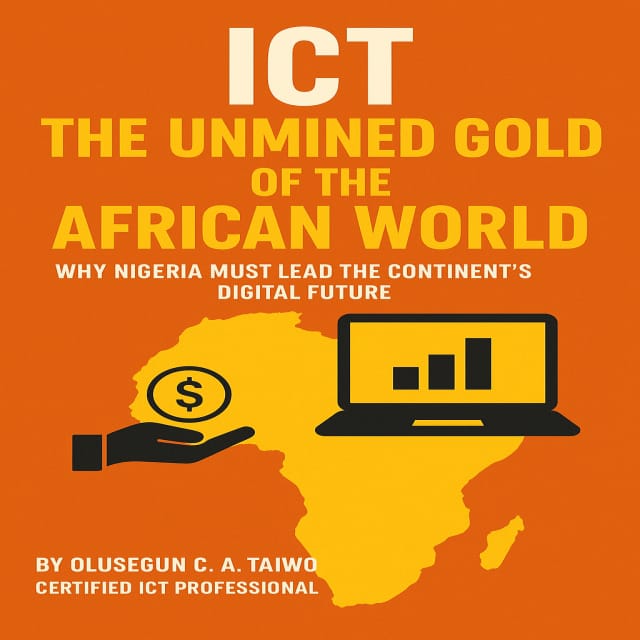
By Olusegun C. A. Taiwo (OCAT), GMCPN

In the last two decades, scholars across Africa and beyond such as Manuel Castells, Tim Unwin, Ernest Wilson, and Nigeria’s own Prof. Umar Danbatta have consistently argued that Information and Communications Technology (ICT) is not merely a tool for development but a transformative engine capable of reshaping entire economies. Castells describes the digital economy as “the new nervous system of global development,” while Unwin emphasizes that nations that fail to invest in digital capacity will remain “peripheral actors in a networked world.” Yet, despite these long-standing warnings, many African countries Nigeria included continue to treat ICT as an afterthought rather than the goldmine that it truly is.
NIGERIA: A Nation Sitting on Digital Wealth but Digging for Oil
Nigeria’s most significant challenge is not a lack of ICT talent or innovation. On the contrary, Nigeria produces tens of thousands of ICT graduates every year from institutions such as FUTA, OAU, UI, UNILAG, LAUTECH and polytechnics across the federation. Research from the National Bureau of Statistics and studies by scholars like Afolabi and Oyelaran-Oyeyinka repeatedly show that Nigeria has a high density of youth with ICT skills, creativity, and entrepreneurial drive.
Amotekun Corps Announces Fresh Batch Recruitment Exercise — Apply Now
However, successive governments have historically failed to harness this local capacity. Instead, Nigeria Africa’s largest economy continues to rely excessively on oil and gas. This overdependence has caused policymakers to overlook the ICT sector, where the value chain is far more sustainable and inclusive than fossil-fuel revenue cycles.
As several economic researchers have argued, including the African Development Bank (AfDB), a digital-driven economy could generate more steady, diversified income for Nigeria, reduce unemployment, improve transparency, and expand global competitiveness. Yet, the country continues to import foreign ICT solutions, foreign consultants, and foreign software neglecting its own local ICT professionals.
Lack of Support for Local Content: A Persistent National Weakness
One of the biggest contradictions in Nigeria’s development strategy is its failure to implement, enforce, and expand the Local Content Act in ICT. While the Nigeria Oil and Gas Industry Content Development (NOGICD) Act is strongly enforced, the ICT sector continues to suffer neglect.
Dr. Ernest Ndukwe, former Executive Vice Chairman of NCC, once noted that “Nigeria loses billions annually to foreign ICT imports that could be locally developed if government trusted domestic expertise.” His position has been supported by researchers like Banji Oyelaran-Oyeyinka, who stresses that indigenous technological capability is a prerequisite for real national development.
Makinde vs APC: Inside the Black Book of His So-Called “Offenses” | By OCAT
Unfortunately, Nigerian ICT professionals especially those trained locally rarely receive contracts, technical appointments, or large-scale government projects. Instead, ministries and agencies outsource critical ICT work to foreign companies that, at best, recycle solutions that local engineers could build at far lower cost.
This systemic disregard has contributed to unemployment, skills flight, and the underutilization of Nigeria’s digital talent pool.
A POSITIVE LIGHT: WAEC’S TEST RUN OF COMPUTER-BASED TESTING (CBT)
One encouraging development is the West African Examinations Council (WAEC)’s recent test run of Computer-Based Testing (CBT). Academics such as Prof. Niyi Akinnaso have long advocated for the digitization of high-stakes exams, arguing that CBT improves transparency, reduces malpractice, and aligns education with 21st-century digital realities.
‘He’s Industrious and Trustworthy’— Egalitarian Extols OCAT on his Birthday
WAEC’s pilot implementation is proof that Nigeria is capable of embracing technological reform if the political will exists. The challenge now is ensuring that such digital transformation projects are powered by Nigerian ICT professionals, not outsourced unnecessarily to foreign contractors.
RECOMMENDATIONS FOR STATE AND FEDERAL GOVERNMENTS
1. Institutionalize Local ICT Content Policies
Government must adopt and enforce ICT-equivalent frameworks similar to the Local Content Act in the oil and gas sector. Ministries, agencies, and parastatals should be mandated to work with Nigerian ICT companies and professionals first.
2. Create ICT Ecosystems in All States
Every state should establish innovation hubs, coding academies, and digital research centers. Several studies, including those by the World Bank, show that decentralized digital ecosystems promote innovation, SME growth, and youth empowerment.
3. Priority Recruitment of Nigerian-Trained ICT Professionals
Government recruitment should intentionally prioritize graduates of Nigerian tertiary institutions, many of whom have world-class skills but lack opportunities. This will reduce unemployment and strengthen local capacity.
4. Strengthen Collaboration Between Academia and Government
ICT departments in universities and polytechnics should collaborate with state ICT ministries for curriculum updates, internships, and real-life deployment of innovations. Researchers like Oyelaran-Oyelinka argue that innovation thrives where academia and government work hand-in-hand.
5. Reduce Reliance on Foreign ICT Solutions
The federal government must limit unnecessary importation of foreign software and hardware, especially for critical national infrastructure. Local alternatives exist and can be strengthened with investment.
6. Support Local Startups Through Grants and Technical Partnerships
Inspired by Kenya’s Konza Technopolis and Rwanda’s Kigali Innovation City, Nigeria should support startups through grants, low-interest loans, and incubation programs. This can create millions of ICT-related jobs.
7. Fully Digitize Government Operations
States and federal agencies should adopt e-governance, digital records management, electronic procurement, and automated service delivery. This improves efficiency, reduces corruption, and expands ICT demand.
CONCLUSION
ICT remains Africa’s most unmined gold — an abundant resource waiting for intentional investment. Nigeria’s young ICT professionals, especially those trained in Nigeria’s institutions, hold the key to a diversified and prosperous digital economy. But until the government prioritizes local content, reduces dependence on oil, and embraces digital transformation, the nation will continue to chase outdated revenue models while ignoring the gold beneath its feet.
The future of Nigeria’s development lies not in oil wells, but in digital minds. It is time for leaders to act.
Olusegun C A Taiwo OCAT PGDJ, GMCPN