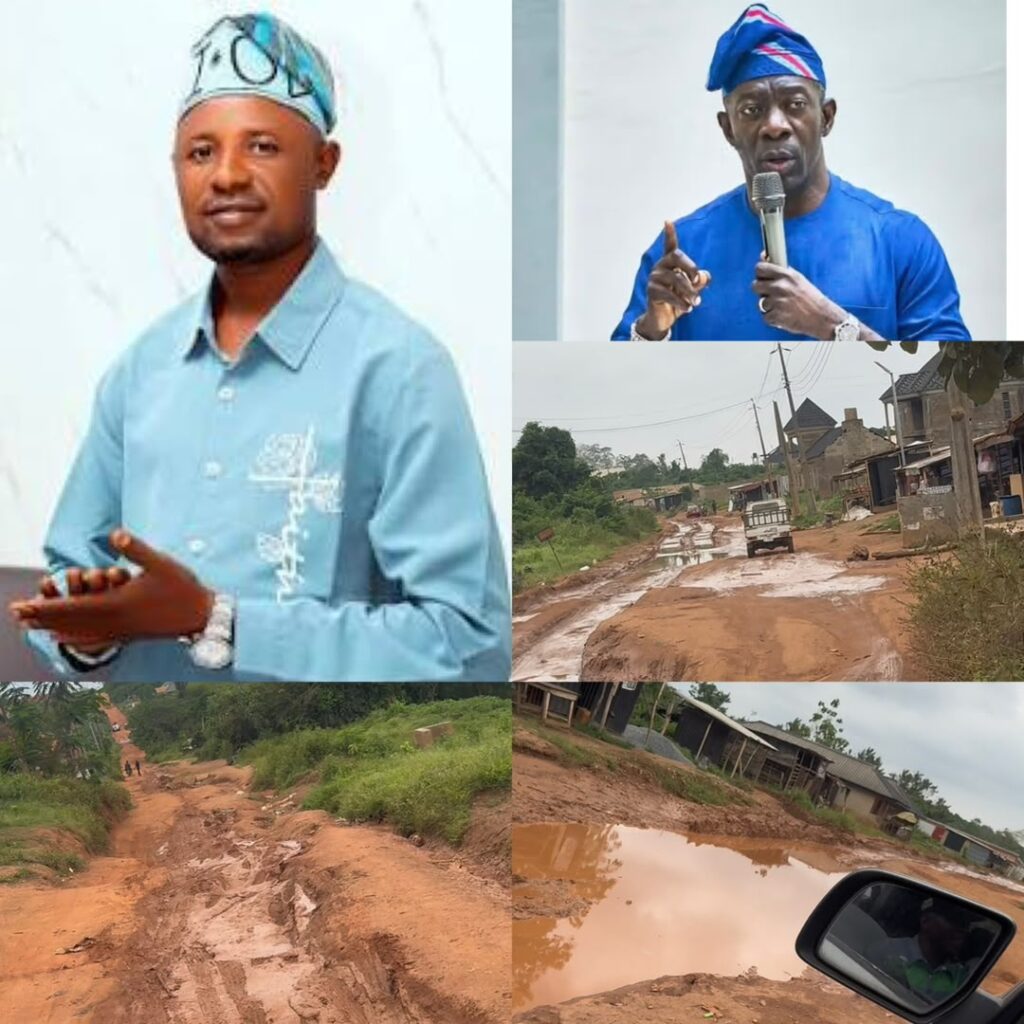
“You Must Look Towards Your Father’s Hometown Before Lecturing Oyo State on Development” – Mogaji Alawode Chides Bimbo Adekanmbi

Community development advocate and Mogaji of Ifatayo-Alawode Compound of Ibadanland, Mogaji Rahmon Alawode, has challenged former Oyo State Commissioner for Finance, Mr. Bimbo Adekanmbi, to demonstrate what his political experience and influence have contributed to community development, particularly concerning the deplorable condition of the Olorunda–Gbada Efon Road in Ward 4, Ona Ara Local Government.
Alawode specifically noted that the road serves as an important access route linking communities in the area to Gbangba, the hometown of Mr. Bimbo Adekanmbi’s father, making its prolonged neglect an issue that deserves attention from all stakeholders, particularly individuals with political experience and connections to the community.
He also called on Governor Seyi Makinde’s administration to explain its rural infrastructure priorities, insisting that the condition of the road raises serious questions about equitable development, public accountability and the government’s commitment to rural communities across Oyo State.
According to him, the issue goes beyond political differences or personalities, stressing that the welfare, economic survival and dignity of residents who depend on the road must take precedence.
“A ROAD CAN BE NEGLECTED, BUT THE PEOPLE WHO DEPEND ON IT MUST NEVER BE FORGOTTEN.”
ADEKANMBI: WHAT HAS YOUR POLITICAL EXPERIENCE DELIVERED TO YOUR FATHER’S HOMETOWN?
Alawode observed that Mr. Bimbo Adekanmbi is not a political newcomer, having previously served as Commissioner for Finance in Oyo State, a position that exposed him to government budgeting, capital expenditure, public resource allocation and infrastructure financing.
He consequently questioned what efforts Adekanmbi had made through his political relationships and influence to draw government attention to the deplorable condition of the Olorunda–Gbada Efon Road, which links the surrounding communities to Gbangba, his father’s hometown.
He asked whether the former commissioner had formally advocated its rehabilitation, approached successive administrations or engaged relevant ministries and government representatives to seek a lasting solution to the transportation challenges confronting residents of the area.
He, however, clarified that the questions were not accusations that Adekanmbi personally controls government infrastructure budgets, but legitimate expectations of a public figure whose political experience and influence should translate into meaningful community development.
Alawode maintained that political relevance should not be measured merely by access to power, but by the positive difference such access makes in people’s lives.
He added that before offering lectures on development and the future of Oyo State, Adekanmbi should also look towards his father’s hometown and demonstrate what his political experience has contributed to the development of the community connected to his family heritage.
MAKINDE GOVERNMENT: WHERE IS THE RURAL DEVELOPMENT DIVIDEND?
Turning his attention to Governor Seyi Makinde’s administration, Alawode maintained that the responsibility for public infrastructure rests with the appropriate government authorities, making it necessary for the state government to account for its rural road development priorities.
He referenced reports of November 10, 2026, indicating that Governor Makinde presented a proposed ₦1.12 trillion budget for the 2027 fiscal year, with approximately ₦236.15 billion earmarked for infrastructure.
He argued that while the figures appear substantial, the people of Oyo State deserve more than impressive budget presentations.
According to him, residents deserve completed projects, accessible roads, transparent procurement processes and measurable improvements in their standard of living.
He therefore raised critical questions concerning the implementation of the 2026 budget, the status of previously announced road projects, the actual release and utilisation of infrastructure funds, and whether the Olorunda–Gbada Efon Road has been captured in any government development programme.
“A budget is not an achievement simply because it has been announced. Its true value lies in its implementation and the tangible benefits delivered to the people.
“A trillion-naira budget means very little to a rural farmer who cannot conveniently transport agricultural produce to the market because of a neglected road,” he stated.
DEVELOPMENT MUST NOT END WHERE POLITICAL CONVENIENCE ENDS
Alawode expressed concern over what he described as a political culture in which some rural communities receive significant attention during election campaigns but are subsequently left to contend with poor roads, inadequate infrastructure and limited economic opportunities.
He stressed that the people of Gbada Efon, Gbangba and neighbouring settlements deserve the same consideration as residents of major urban communities across the state.
He further noted that their votes carry the same constitutional weight as those of residents of Bodija, Jericho, Ring Road, Akobo and other urban communities.
He insisted that rural development must never become a casualty of political calculations, adding that every community deserves equitable access to infrastructure and opportunities.
FIVE DEMANDS TO THE OYO STATE GOVERNMENT AND RELEVANT STAKEHOLDERS
In the interest of transparency, accountability and sustainable community development, Mogaji Alawode made five specific demands:
1. Road Condition Assessment: The Oyo State Government should conduct and publish a comprehensive engineering assessment of the Olorunda–Gbada Efon Road, including its present condition and rehabilitation requirements.
2. Budget Transparency: The government should disclose whether the road featured in any approved state or local government budget between 2019 and 2026, alongside relevant allocations and expenditure.
3. Contract Accountability: Relevant authorities should clarify whether any rehabilitation or reconstruction contract has been awarded for the road and, where applicable, provide details of its implementation status and expected completion timeline.
4. Immediate Government Intervention: Appropriate emergency repairs should be undertaken where necessary while a sustainable rehabilitation programme is developed.
5. Political Accountability: Mr. Bimbo Adekanmbi should publicly explain the advocacy efforts and interventions he has pursued towards the development of Gbangba, his father’s hometown, and the surrounding communities served by the road.
Alawode described these demands as reasonable and consistent with the principles of responsible leadership, transparency and accountable governance.
A MESSAGE TO BIMBO ADEKANMBI
Addressing the former commissioner directly, Alawode maintained that leadership goes beyond political debates, defending political interests or projecting future ambitions.
He stated that genuine leadership also involves remembering the communities that shaped one’s beginnings and ensuring that the people connected to those communities are not forgotten.
He challenged Adekanmbi to make public any meaningful interventions he had undertaken concerning the road, explain the obstacles encountered where applicable, and provide relevant details if the road had already been captured in a government development programme.
“Silence must not replace accountability.
“Before political leaders ask the people of Oyo State to trust their vision for tomorrow, they must be willing to demonstrate their contributions to the communities they have had opportunities to serve,” he added.
A FINAL WORD TO THE PEOPLE OF OYO STATE
Alawode described himself as a son of Ibadanland, entrepreneur, community and youth development advocate who believes that infrastructure should never be treated as a privilege reserved for politically influential communities.
He explained that poor road infrastructure destroys farmers’ profits, increases transportation costs, discourages investment, isolates rural settlements and limits opportunities for young people.
He emphasised that the Olorunda–Gbada Efon Road should be treated as a genuine development concern rather than another political talking point.
He further clarified that the demand for the road’s rehabilitation was not based on the fact that it links to the hometown of a prominent politician’s father, but on the fact that ordinary Nigerians live, work, farm, trade and raise families in the communities it serves.
He concluded that history would not remember political leaders solely for the budgets they presented, the political battles they fought or the offices they occupied, but also for what became of the communities they had the opportunity to serve.
“LET THE OLORUNDA–GBADA EFON ROAD BECOME A ROAD TO ACCOUNTABILITY, NOT ANOTHER MONUMENT TO UNFULFILLED DEVELOPMENT PROMISES.”
He maintained that Oyo State deserves better, rural communities deserve better, and the people deserve answers.
SIGNED:
MOGAJI RAHMON ALAWODE
Community Development Advocate
Ibadan, Oyo State.